News Can Urban Lakes Save Our Cities from Flooding? The Future of Sustainable Drainage in India and Jharkhand
How population growth, architecture, lake conservation and integrated stormwater management can strengthen urban water security and build climate-resilient cities.
Why Urban Lakes Matter More Than Ever
India's population is projected to reach approximately 1.477 billion in 2026, while Jharkhand's population is projected at around 41.11 million. These figures are projections, not new Census counts. Population growth and urbanisation are increasing demand for housing, drinking water, sanitation, roads, public spaces and drainage infrastructure.
As cities expand, concrete buildings, paved roads and other impervious surfaces reduce natural rainwater infiltration and increase surface runoff. Encroachment, pollution and inadequate drainage further expose urban areas to waterlogging, flooding and seasonal water shortages.
Urban lakes should therefore be recognised as essential blue-green infrastructure. Their conservation must be integrated with architecture, landscape design, infrastructure development and municipal drainage planning.
Population Growth, Water Demand and Urban Lakes
Population growth increases water demand across residential, commercial, institutional and industrial developments. It also generates more wastewater and increases the volume of stormwater flowing from developed areas.
According to the 2011 Census, 31.1% of India's population and approximately 24% of Jharkhand's population lived in urban areas. A 2025 Population Foundation of India and International Institute of Migration and Development study projects Jharkhand's urban share at 29.8% in 2026. These trends highlight the importance of planning water infrastructure for future urban growth.
Urban lakes and reservoirs contribute to sustainable development through:
Permanent lake storage and stormwater detention serve different purposes. Storage retains water over time, while detention temporarily holds excess runoff before controlled release. Drinking-water use requires appropriate treatment and regular quality monitoring.
Architecture and Water-Sensitive Urban Design
Sustainable water management begins at the building and site-planning level. Architecture can reduce pressure on municipal drainage networks through water-sensitive design.
Rainwater harvesting: Residential, commercial and institutional buildings can collect rooftop rainwater for storage or suitable groundwater-recharge systems.
Permeable landscapes: Permeable paving, green roofs, landscaped courtyards, bioswales and rain gardens help slow runoff and encourage infiltration where site conditions allow.
Lake-sensitive development: Lakefront development should protect natural inlets, outlets, flood-storage areas and ecological buffers. Shaded walkways and native plantations can improve public spaces without disturbing sensitive habitats.
Building and site planning: Building setbacks, finished floor levels, site grading and surface drainage should follow applicable regulations and flood-risk assessments. New development should not transfer runoff or flood risk to neighbouring properties.
Integrated Drainage Systems: An Engineering Approach
An effective urban drainage network connects rooftop rainwater systems, roadside drains, inlets, culverts, underground stormwater pipes, detention ponds and natural drainage channels.
Drainage planning requires catchment mapping and assessment of rainfall intensity, land slope, soil infiltration, surface cover and downstream outlet capacity.
A preliminary estimate of peak runoff can be calculated using the Rational Method:
Q = 0.00278 × C × I × A
Where:
This is a preliminary estimation method. Detailed drainage design must follow applicable engineering standards and suitable hydrological and hydraulic modelling.
Stormwater and sewage networks should remain functionally separate. Untreated domestic and industrial wastewater must not enter lakes. Drainage systems also require safe outfalls, regular desilting, maintenance access and overflow routes for extreme rainfall events.
Indian Case Study: Jakkur Lake, Bengaluru
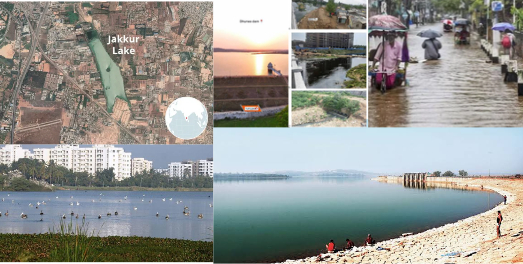
Jakkur Lake demonstrates how engineering infrastructure and ecological restoration can work together. Its restoration includes desilting, boundary protection, sedimentation traps and a constructed wetland through which treated wastewater passes before entering the lake.
The National Institute of Urban Affairs documents the integration of upgraded wastewater treatment, constructed wetlands and biodiversity measures at Jakkur.
The important lesson is that lake restoration must address the entire catchment, sewage inflows, water quality and surrounding land use. Waterfront beautification alone cannot deliver long-term ecological and water-management benefits.
Jharkhand: Protecting Lakes and Planning Growing Cities
Jharkhand's urban centres need coordinated planning to protect water resources and improve drainage infrastructure.
Ranchi: Kanke Lake, Dhurwa Reservoir, Bada Talab and the Harmu River corridor should be considered in catchment-level planning. The Ranchi Master Plan 2037 provides a planning reference for ecological areas, rivers and reservoirs.
Jamshedpur: Dimna Lake, near the Dalma Hills, is an important reservoir associated with the city's water supply. Protecting its catchment, managing runoff and controlling pollution are essential for long-term water security.
Dhanbad and Bokaro: Industrial and residential expansion makes the protection of traditional ponds, natural drainage channels and stormwater routes increasingly important. Drainage-capacity assessments and wastewater management should guide new development.
These locations provide planning contexts. Their current water quality, boundaries and drainage conditions should be verified through local surveys.
How Jharkhand Can Prepare for Future Water Demand
The State Government, urban development authorities and municipal bodies should adopt a coordinated, catchment-based approach:
Suitable AMRUT 2.0 funding and other public programmes can support water-body rejuvenation, sewerage, rainwater harvesting and green infrastructure. Community participation is also important to prevent dumping, encroachment and damage to restored water bodies.
Technology for Future-Ready Cities
Digital technologies can improve the planning and management of urban water infrastructure. GIS and remote sensing help map catchments and monitor land-use changes. Building Information Modelling (BIM) can coordinate building and site drainage, while hydrological and hydraulic modelling can assess runoff and drainage capacity.
Sensors and digital monitoring systems can track water levels and infrastructure performance. However, technology must be supported by reliable surveys, trained municipal teams, updated records and long-term maintenance budgets.
Can Planning Around Water Create Better Cities?
Population growth makes water security and drainage infrastructure central to sustainable urban development. Protecting lakes, restoring natural drainage channels and integrating water-sensitive architecture can help Indian cities manage rainfall, reduce flood risk and preserve valuable water resources.
For Jharkhand, the way forward is to connect population-based infrastructure planning with lake conservation, wastewater treatment, catchment management and statutory urban master plans.
At ABIRIBA LIMITED, we believe architecture, engineering, landscape design and urban planning must work together to create environmentally responsible and future-ready cities.
Designing with water. Planning with nature. Building sustainable futures.
Frequently Asked Questions (FAQs)
Urban lakes support water storage, groundwater recharge, biodiversity and local ecological balance. They can also help manage stormwater runoff when their catchments, inlets, outlets and flood-storage areas are properly protected.
Sustainable drainage systems manage rainwater close to where it falls. Permeable surfaces, rain gardens, bioswales, detention ponds and connected drainage networks slow runoff, encourage infiltration where suitable and reduce pressure on conventional drains.
Architecture can support water conservation through rooftop rainwater harvesting, efficient site planning, permeable landscapes, green roofs, rain gardens and appropriate water-reuse systems. These measures can reduce runoff and demand for treated municipal water.
Lakes and reservoirs around Ranchi, Jamshedpur and other urban centres are important for water security, ecological protection and stormwater management. Protecting their catchments and preventing pollution can support sustainable urban development.
Stormwater drainage carries rainwater runoff from roofs, roads and open spaces. Sewage drainage carries wastewater from toilets, kitchens and other domestic or industrial sources. Keeping the systems functionally separate helps prevent untreated wastewater from polluting lakes and natural water bodies.
GIS helps map catchments, water bodies, drainage channels and land-use patterns. Hydrological and hydraulic modelling estimates runoff, identifies potential flooding locations and assesses whether existing or proposed drainage infrastructure has adequate capacity.
References and Further Reading